At this time of year there are a declining number of nectar rich plants in flower but still plenty of moth species to see.
One of the best ways to attract moths and do them a good turn is to use a technique known as sugaring whereby a treacly mixture is painted onto fence posts or tree trunks avoiding lichens and mosses which are important habitats for micro-moths.
The recipe is as follows courtesy of Butterfly Conservation website.
Sugaring
Moths will also come to artificial nectar called “sugar”. Heat about 500ml of brown ale (or cola) in a large pan and simmer for five minutes to remove alcohol and other chemicals. Then stir in and dissolve about a kilogram of dark brown sugar, followed by a tin of black treacle. Simmer the mixture stirring well to make sure the molasses have all dissolved and then allow it to cool before transferring it to a suitable container for carrying outside. A drop of rum stirred in before use is recommended, but not essential. Just before dusk, use a brush to paint the mixture at eye level onto tree trunks or fence posts. Check the “sugar” for moths with a torch during the first two hours of darkness. Store the remainder in a kiln jar or tin and use on other occasions through the season.
Wine Ropes
An alternative method to sugaring uses thick cord or cloth made from absorbent material. You will need an old fashioned pyjama cord or strips of material 1cm wide by 1m long. Boil the material for at least 10 minutes to remove chemicals. Heat a bottle of cheap red wine in a pan, stir in and dissolve a kilogram of sugar and, after cooling, soak metre lengths of the cord or twisted cloth in the mixture. Drape these “wine ropes” over low branches, bushes or fences just before dusk and later check for moths by torch-light.

Sunday, 6 October 2013

Saturday, 5 October 2013
....And Dark Sword-grass!
Just up the valley from Tony and Ina's last night we also caught three migrants - a Dark Sword-grass, a Vestal and a Silver Y. The last time we caught a Dark Sword-grass was in August 2010 and a Vestal in October 2011.
Carolyn & Evan
Carolyn & Evan
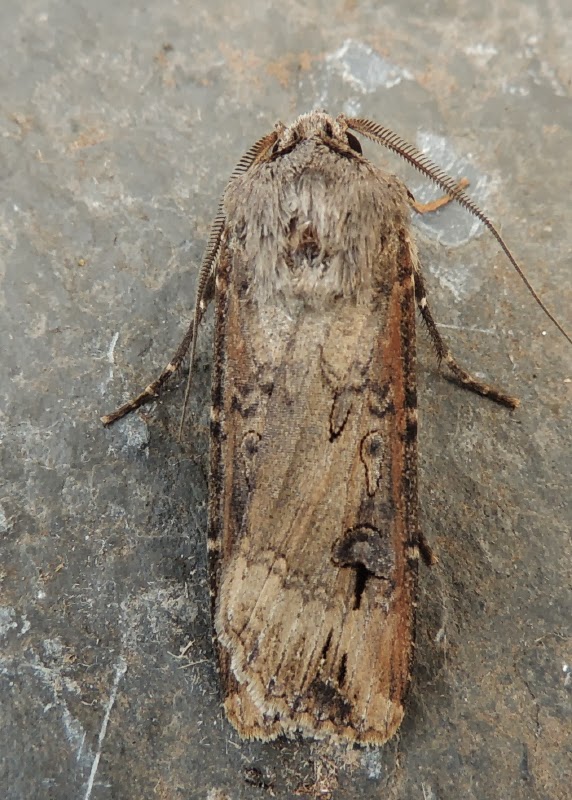 |
| Dark Sword-grass |
 |
| Vestal |
Migrant Night !
You know the feeling, you wait ages for a bus and then lots come along at the same time.
Last night in Talybont - 2 Vestal, 3 Rush Veneer and good old faithful 10 Silver Y.
Could they feel happier about dropping in because we now have street lights that go out shortly after midnight?
Also a female Large Wainscot - these can wander far from their breeding site.
Last night in Talybont - 2 Vestal, 3 Rush Veneer and good old faithful 10 Silver Y.
Could they feel happier about dropping in because we now have street lights that go out shortly after midnight?
Also a female Large Wainscot - these can wander far from their breeding site.
 |
| Vestal |
 |
| Rush Veneer |
 |
| Large Wainscot |
Thursday, 3 October 2013
Frosted orange
The Frosted Orange will always sound like the name of a 1950s lipstick to me, but today I met the creature in the flesh, at the Coed Phoenix moth trap, in Bronant. Tony and Ina had kindly come along to set up their 2 traps with my single Heath, and in spite of the very heavy rain, we managed to get 125 individuals all in, which included 15 species that were new to us on the reserve, including: Black Rustic; Chevron; Flounced Chestnut and of course, the Frosted Orange. We send all our records to the Local Record Centre - WWBIC. We hope to get a lot more local people into moths over the next year.
Sent by Chloe Griffiths
 |
| Frosted orange |
Coed Phoenix moths
Despite a very wet night we had well over 100 moths in 3 heath traps at Coed Phoenix last night, with 21 species of macro moths. 35 Red-line quaker, 13 Yellow-line quaker, 31 Spruce carpet, 12 Flounced chestnut, 6 Green-brindled crescent, notable singletons of Small phoenix, Frosted orange, Red sword-grass, Autumn green carpet, Brick, Sallow and Chestnut.
 |
| Autumn green carpet |
 |
| Flounced chestnut |
 |
| Green-brindled crescent and Red-line quaker |
 |
| Red sword-grass |
Wednesday, 2 October 2013

Tuesday, 1 October 2013
Blair's shoulder-knot
This moth was not recorded in Ceredigion before the 1980's according to Adrian Fowles. It was first discovered on the Isle of Wight in 1951 and has been moving north very quickly since then. Could the spread be related to abundance of Lawson's and Leyland Cypress, the larval food plants. We recorded good numbers in the garden last year, and we had our first for this year last night.

Subscribe to:
Posts (Atom)