The vc46 2015 Moth Report is available by clicking HERE Opens as a PDF
If anyone is struggling with Dropbox and would like a copy emailed to them direct please let us know.
There are some dates for your diary on the last page which will eventually appear on the blog events page.
Ina and Tony
Tuesday, 9 February 2016

Friday, 5 February 2016
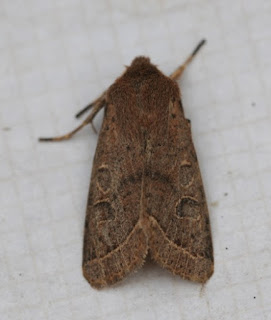
Common quaker
Pete Skinner reported this Common quaker from his trap last night. There have been several unusually early records of this moth from around the country, and this is the earliest record for VC46 by 6 days. He also caught several Chestnut moths.
Correction: As Evan has pointed out ( see comments) this is actually only the fourth earliest county record for Common quaker. The earliest records are: 03/01/2013, 09/01/2016, 30/01/1989.
 Tony
Correction: As Evan has pointed out ( see comments) this is actually only the fourth earliest county record for Common quaker. The earliest records are: 03/01/2013, 09/01/2016, 30/01/1989.

Eglwysfach last night
A couple of pugs last night and another Mottled Grey.
Apart from that only the usual suspects, Pale Brindled Beauty, Dotted Border, Chestnut, Mottled Umber and lots of Tortricodes alternella.
Apart from that only the usual suspects, Pale Brindled Beauty, Dotted Border, Chestnut, Mottled Umber and lots of Tortricodes alternella.
 |
| Double-striped Pug |
 |
| Brindled Pug |
 |
| Mottled Grey |
 |
| Pale Brindled Beauty f.monacharia |
Monday, 1 February 2016
National Moth Recorders Meeting 2016
Tony and I had another interesting day at the National Moth Recorders Meeting in Birmingham on Saturday.
Some very interesting speakers and presentations that I am not going to go into now as these may well be available on YouTube before very long, watch this space.
Some very interesting speakers and presentations that I am not going to go into now as these may well be available on YouTube before very long, watch this space.
If you would like to see if there is anything that interests you the agenda for the day can be viewed in the new copy of Emoth by clicking here
New! National Micro-moth Recording Scheme
Probably the single biggest and arguably most important announcement is that from 1st April, the National Moth Recording Scheme will start to accept micro-moth records for the first time! Micro-moth records, however, will go through a more thorough verification process than macro-moths.
Every species and commonly-recorded stage has been allocated a grade similar to the grades on some moth group websites. All records within reason will be verified according to these criteria - by the way, these national grades and recording criteria have been designed by many acknowledged taxa experts, people with a vast amount of experience and know what they are talking about. However, there will be instances where local grades and rulesets may overrule the national guidelines. I will ensure these guidelines are made available in due course along with any other relevant details for the recording and verification of micro-moths.
There are now three possible levels of verification:
Firstly, the County Recorder (CMR); if, for any reason, I feel I am unable to verify a species' record, I will now have at my disposal a Regional Verification Panel (RVP) of experts in order to help me make an informed decision.
If, for any reason, the RVP are unable to verify that record, it will be referred to a National Verification Panel of experts for a final decision.
The NVP will also have access to the full dataset in the National Moth Recording Scheme for final verification checks as they see fit.
In all instances, the CMRs, or Verification Panel’s decision will be final. There will be feedback throughout the verification process.
The data we provide to the national schemes must be robust as our data are used to make informed policy and conservation decisions.
Monday, 25 January 2016
Winter woodland moths
It was a balmy 15C with a light breeze when we set two traps in predominantly oak woodland last night. The high winds later on removed the light from one of the traps but the light kept running and we still had a reasonable catch: 7 Spring usher, 4 Dotted border, 14 Chestnut, 3 Winter moth, 2 Mottled umber, 1 Pale brindled beauty, and 22 Tortricodes alternella.
Tony & Ina
 |
| Dotted border |
Sunday, 24 January 2016
Our First Spring Ushers
Following our excellent social moth gathering in Aberaeron we were inspired to put out two traps last night. The minimum temperature was 8°C. The trap in oak woodland produced 16 Spring Ushers of two main forms, seven Chestnuts, four Winter Moths and two Tortricodes alternella (FL 11mm). In the more exposed garden trap we had just one Winter Moth and one Satellite.
Carolyn & Evan


Carolyn & Evan


Saturday, 9 January 2016
Common Quaker
We were surprised to find this Common Quaker in our garden trap this morning along with plentiful Winter Moths and one Mottled Umber. According to Waring these usually appear March to May but small numbers may emerge in mild spells during late autumn and winter. This was a first for us and seems to fit with the abnormally mild weather conditions for this time of year, another sign of which were the plentiful number of garden slugs on the trap.
Carolyn & Evan

Carolyn & Evan

Subscribe to:
Posts (Atom)